Table of Contents
ToggleDim interiors — basements, north-facing rooms, interior offices, narrow hallways — present a genuine decorating challenge. Without abundant natural light, conventional houseplant wisdom tends to fall short. Yet greenery’s transformative power doesn’t hinge on a sun-drenched windowsill. The right plants, placed thoughtfully, can boost mood, improve air quality, and bring natural warmth to even the shadowiest corners of a home or workspace. Low-light plants offer resilient, stylish solutions that go far beyond the expected — and knowing how to select, arrange, and care for them opens up an entirely new dimension of interior design.
Understanding Low-Light Plants for Dim Environments
Low-light conditions generally describe spaces receiving fewer than 100 foot-candles of illumination — roughly the level produced by standard indoor ambient or fluorescent lighting, with no direct sun exposure. Many plants have evolved to thrive in precisely these settings, drawing on high chlorophyll efficiency and a natural shade tolerance developed in rainforest understories. For those looking to furnish these tricky areas without the guesswork, choosing curated easyplant low light plants ensures you receive species that are specifically adapted to drawing moisture and nutrients efficiently even when the sun is scarce.
Several species stand out for their resilience in dim conditions: the Snake Plant (Sansevieria), Peace Lily (Spathiphyllum), ZZ Plant (Zamioculcas zamiifolia), Pothos (Epipremnum aureum), Heartleaf Philodendron, and Chinese Evergreen (Aglaonema) are all proven performers in low-light interiors. A ZZ Plant tucked into a dim home office, for instance, can hold its lush, glossy foliage for months on little more than bi-weekly watering and indirect fluorescent light. Worth noting: certain varieties like variegated Spider Plants actively purify indoor air, removing toxins such as formaldehyde from the environment.
Creative Placement Strategies Beyond Traditional Spots
Vertical Greenery Walls and Hanging Displays
Trailing plants like Golden Pothos or Philodendron ‘Lemon Lime’ take beautifully to wall-mounted fabric pockets or macramé hangers, turning bare walls into living art. Layering low-light ferns — the Blue Star Fern being a particularly good choice — across a living wall panel creates a lush, forest-like backdrop, even in a windowless hallway.
Floor and Statement Plant Arrangements
Tall, sculptural species like Parlor Palm or Corn Plant serve as natural focal points when positioned in room corners, especially when elevated on pedestal stands. Grouping Snake Plants of varied heights around furniture legs mimics a natural understory effect, adding depth without visual clutter.
Shelf and Surface Innovations
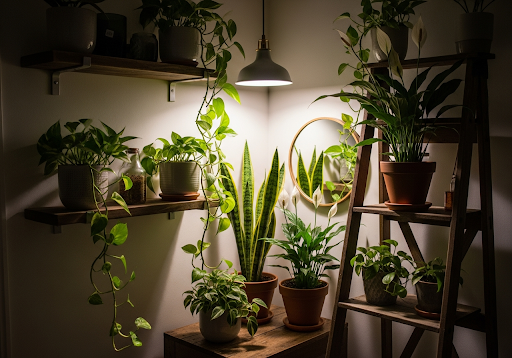
Compact specimens like Polka Dot Plants or Peperomia cluster well on floating shelves. Placing reflective trays beneath pots subtly amplifies ambient light, while positioning mirrors behind the shelves — particularly effective with a Calathea Rattlesnake — meaningfully improves light diffusion across the foliage.
Innovative Display Techniques for Maximum Impact
Leaning ladder shelves offer one of the most dynamic solutions for dim spaces. Pothos cascading from the upper rungs paired with a sturdy Money Tree anchoring the base creates a layered, space-saving display with real visual impact. In one particularly effective application, a dim bedroom was transformed using a ladder shelf holding Chinese Evergreen and Spider Plants — improving both the aesthetics and the air quality in one move.
For a more integrated approach, built-in cabinetry and open shelving can house Peace Lilies or even a small Monstera used as a room divider. Glass terrariums holding humidity-loving Alocasia Polly make striking coffee table centerpieces while maintaining the moisture these plants prefer.
Where light is especially scarce, LED desk lamps or under-cabinet fixtures tuned to a cool white spectrum — around 5000K — offer gentle supplementation without requiring a full grow-light setup. Rotating plants weekly ensures even growth on all sides when light arrives from only one direction.
Essential Care Tips for Thriving Greenery in Shade
Watering discipline is the single most important factor in dim-space plant care. Snake Plants should dry out fully between waterings — typically every two to three weeks — while Peace Lilies perform best when watered as soon as the topsoil turns dry to the touch. Overwatering in low-light environments is the most common mistake, since reduced evaporation slows soil drying considerably. A simple finger-test — pressing one inch into the soil — reliably prevents the problem.
Aim to maintain humidity between 40–60% using pebble trays filled with water placed beneath pots, and keep temperatures in the 65–75°F (18–24°C) range to replicate the tropical origins most of these species share. Well-draining soil amended with perlite, combined with pots that have drainage holes, is essential for preventing root rot.
Bringing It All Together: Crafting Your Dim-Space Oasis
The path to a thriving dim-space garden is more straightforward than it might seem: choose shade-tolerant species, experiment with vertical and horizontal placements, and commit to minimal but consistent care routines. Start with three to five plants in your dimmest room, observe how they respond over a month, and adjust placement or watering as needed.
The benefits extend well beyond aesthetics. Biophilic design — incorporating natural elements into built environments — is consistently linked to reduced stress and improved well-being, even in spaces that see little natural light. A practical first step: inventory your dimmest room, select two or three plants from the varieties discussed here, and implement one creative display this week. The results tend to speak for themselves.